Preparatory Stage
From curiosity
to understanding
Learning to explore, question, practise and apply.
Classes III to V are where reading becomes reading-to-learn and arithmetic becomes reasoning. Designed in line with NEP 2020, NCF-SE 2023 and CBSE's competency-based approach, this stage builds conceptual clarity, practical application and the first real habits of independent learning.
Six moves, repeated until it sticks
Every unit in Classes III–V runs through the same cycle. Children come to recognise it — and to know where they are in it.
Learn
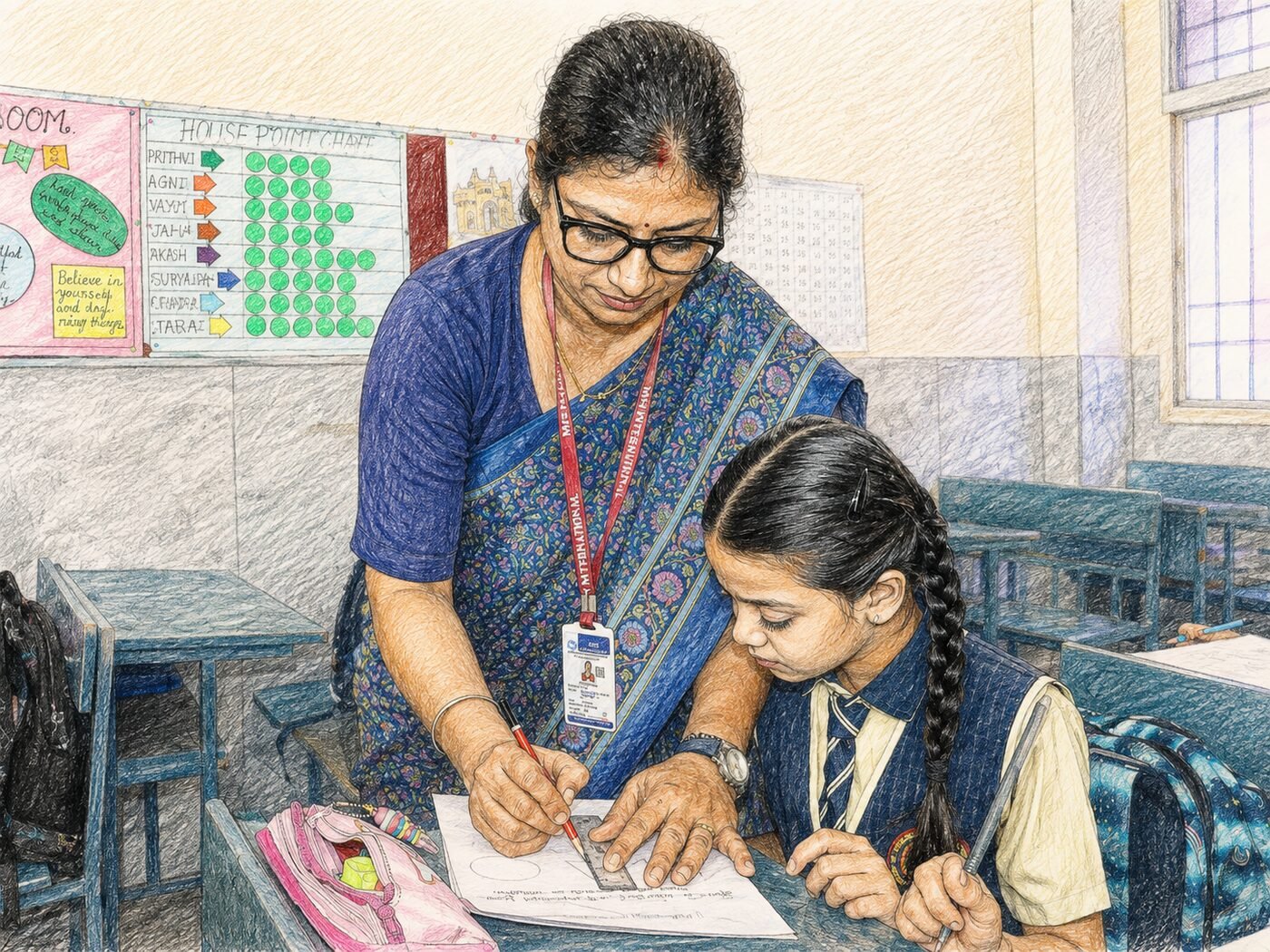
The concept is introduced clearly, with the teacher building from what children already know.
Explore
Inquiry, materials, discussion and ICT resources open the concept up to questions.
Practice
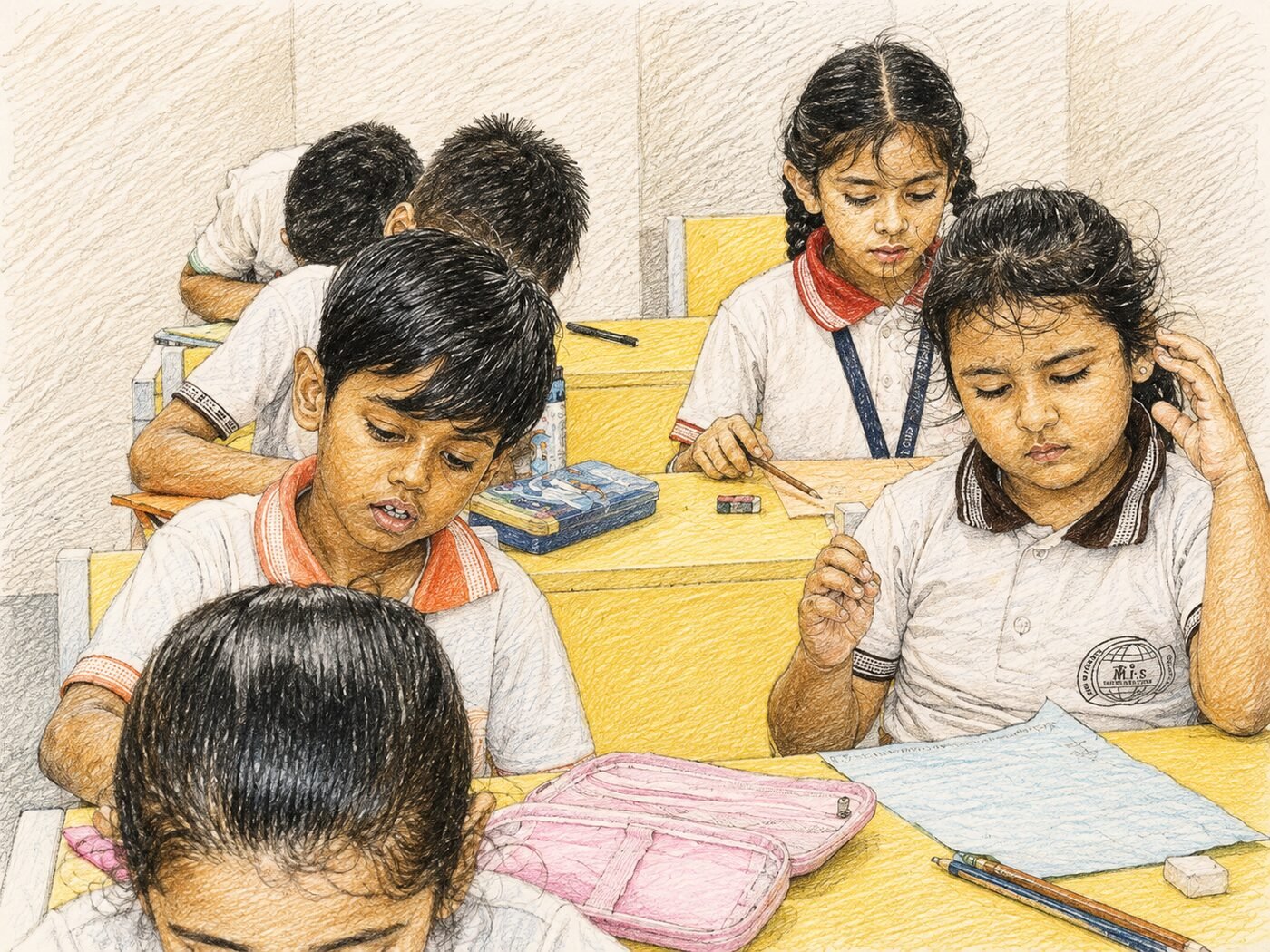
Level-based worksheets and activities give every child the right amount of repetition.
Apply
Projects and real situations ask children to use the concept somewhere new.
Assess
Worksheets, activities, projects and periodic tests show what has actually landed.
Improve
Gaps are addressed through remedial support before the class moves on.
From receiving information to working with it
Experiential learning
Concepts are met first as an experience — a demonstration, an experiment, a walk, an object in the hand — and named afterwards.
Activity-based learning
Children make, sort, measure, dramatise and present. The activity is where the thinking happens, not a reward after it.
Inquiry-driven learning
Lessons open with a question worth answering, and children are taught how to look for evidence rather than for the right page.
ICT integration
Digital resources are woven into lessons for visualisation, practice and presentation where they genuinely add something.
Collaborative learning
Pairs and small groups, with peer learning encouraged — children explain to each other, which is where understanding gets tested.
Critical thinking
Children are asked to justify an answer, compare two methods and spot what does not fit — the habits that carry into the Middle Stage.
The eight capabilities we watch closely
There is a strong emphasis at this stage on reading, writing, communication and spoken English — the skills that determine how well a child can learn everything else.
Reading
Fluency and reading with understanding across subjects.
Writing
Organised paragraphs, description and narration in both languages.
Communication
Listening carefully and speaking clearly to a group.
Spoken English
Daily practice and correction, with confidence as the goal.
Mathematical understanding
Operations, fractions, measurement and data handled with meaning.
Conceptual clarity
Knowing why a method works, not only how to run it.
Reasoning
Explaining, justifying and checking one's own thinking.
Problem-solving
Unfamiliar problems approached with a method rather than a guess.
We assess what a child can do with what they know
Our assessment system evaluates understanding, application, reasoning and problem-solving rather than rote memorisation. Lesson planning is competency-based, and term-wise assessment draws on several kinds of evidence.
What we assess
How we gather evidence
A SAFAL-aligned approach
MPS International follows a SAFAL-aligned approach at this stage: assessment designed to test core concepts and higher-order thinking rather than recall, in the spirit of CBSE's competency-based assessment direction for the Preparatory Stage.
Note for parents: this describes how the school designs its own school-based assessments. Any external or board-level assessment applies only as and when notified by CBSE for the relevant academic session.
Different children, different routes
Support at this stage is about noticing early. A gap in Class III is a small thing; the same gap in Class VII is not.
Early identification
Competency-based worksheets double as a diagnostic — teachers see which children are drifting, and where.
Remedial classes
Dedicated remedial sessions to bridge learning gaps, so children rejoin the class with the concept secured.
Level-based worksheets
Practice pitched to the child rather than the average — including extension work for those ready to go further.
Special Educator support
Inclusive education supported by a Special Educator working with teachers and, where needed, with individual children.
Peer learning
Structured peer support, which helps the child explaining as much as the child listening.
Inclusion as practice
Every child belongs in the room, in the activity and in the house team — support is arranged around that, not instead of it.
From learning concepts to solving problems
Students in Classes III–V are given early exposure to the school's Atal Tinkering Lab — not as a showpiece visit, but as a place where a question can be turned into something that works.
Handling tools and materials at this age builds a particular kind of confidence: the belief that a problem is something you can take apart. It is the same confidence the Middle Stage will ask them to use on abstract ideas.
Leadership is part of the curriculum here
A vibrant School Parliament and eight houses give children real roles, real duties and a real audience — including the Principal.
Elected roles
- Primary Head Boy & Head Girl
- House Captains across eight houses
- School Parliament members
Everyday responsibility
Student monitors are appointed for specific duties, so responsibility is shared widely rather than concentrated in a few children:
Student voice
Student leaders meet the Principal in regular interactive sessions to share feedback and suggestions, and are actively involved in planning and managing school events and programmes.
The Best Class Trophy
Awarded on discipline, behaviour, cleanliness, participation and overall performance — a shared goal that makes a class a team.
Enrichment for every child, not only the talented few
Dance
Music
Art
Sports
Yoga
Theatre
Public speaking
Questions parents ask us
How is Class III different from Class II?
The shift is from learning to read towards reading to learn. Children now meet subjects as bodies of knowledge, work in longer tasks and projects, and begin to be responsible for their own materials, homework and duties.
Are there examinations at this stage?
There are term-wise assessments built from worksheets, activities, projects and periodic tests, in line with the applicable CBSE framework. The emphasis is on understanding and application rather than recall.
My child struggles with spoken English. What happens?
Spoken English is an explicit focus at this stage, practised daily through discussion, presentation and public speaking, with remedial support and level-based practice where a child needs more time.
Is there support for a child with learning difficulties?
Yes. Inclusive education is supported by a Special Educator, alongside remedial classes, level-based worksheets and structured peer learning.
Can a primary child really take part in leadership?
They do. There is a Primary Head Boy and Head Girl, House Captains and a rotating set of class monitor duties, and student leaders meet the Principal to share feedback.
Confident learners.
Curious minds.
Responsible individuals.
At MPS International we don't just teach; we nurture confident, responsible and joyful learners.
Middle Stage · Classes VI–VIII
Questioning, thinking and discovering — where learning becomes genuinely independent.
Explore the Middle Stage ?