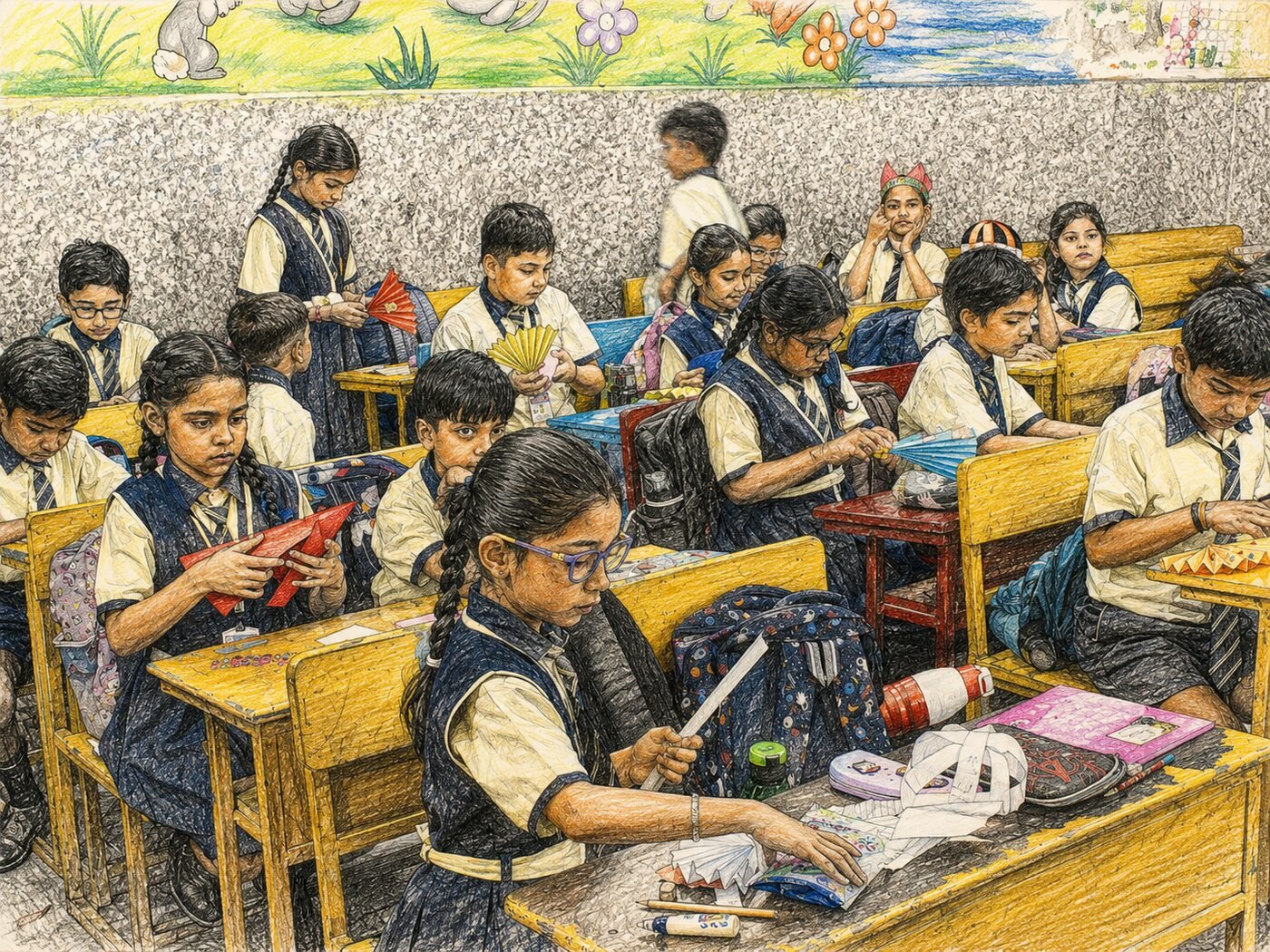
Moving from learning ideas to understanding, questioning and applying them.
We do not see Classes VI to VIII merely as preparation for Classes IX and X. These are the years in which a student begins to engage with abstract concepts, deeper inquiry and real-world application — and begins to take charge of their own learning.
From exploring the world around us
→ to understanding and engaging with it meaningfully.
Our academic programme is aligned with the CBSE curriculum and the vision of NEP 2020 and NCF-SE 2023, with an emphasis on competency-based, experiential, interdisciplinary and student-centred learning.
Our teachers use a deliberate blend of approaches. Which one leads a lesson depends on the concept, not on habit.
Concepts are connected with activities, demonstrations, experiments and real-life situations, so an idea arrives attached to something the student has seen work.
Individually or in teams, students take on projects that require research, planning, problem-solving and a defensible conclusion.
Students are encouraged to ask questions, investigate and reach evidence-based answers — including answers the teacher did not supply.
Connections are drawn across subjects so students see how knowledge works together rather than in seven separate boxes.
Art, creativity and expression are used to make academic concepts more engaging and more memorable.
Group work develops communication, cooperation, listening and leadership — including the harder skill of disagreeing well.
Teachers act as facilitators while students take on more responsibility: setting goals, managing tasks, reflecting on progress and finding their own resources.
Students analyse situations, weigh alternatives and justify their thinking — out loud, in writing and to each other.
Rather than a timetable, here is what a student is actually building in each area of the Middle Stage curriculum.
Reading with discrimination, writing with structure, speaking with confidence — and, through a third language, a genuine sense of how languages are built. Language options are offered as applicable for the session.
Reasoning & application
Conceptual understanding and mathematical reasoning, problem-solving, and the application of mathematics to everyday situations — supported by hands-on work in the Mathematics Lab.
Integrated approach
Physics, Chemistry and Biology concepts taught in an integrated way, with laboratory work and a real emphasis on observation, experimentation and scientific inquiry.
History · Geography · Social & Political Life
Understanding society, culture, environment and citizenship — reading evidence, comparing accounts and thinking about how communities are organised.
Kaushal Bodh · CT & AI
Computer Science and digital literacy, exposure to computational thinking and artificial intelligence, coding and technology-based activities, and Skill Education (Kaushal Bodh) — innovation and problem-solving as taught habits.
Every student, every week
Art, craft and drawing; music; physical and health education; sports; yoga and wellness; life skills and value education; clubs and house activities; NCC / Scouts & Guides opportunities; community service and social awareness.
The exact combination and timetable of subjects and activities may vary by grade and academic session, in accordance with CBSE requirements and the school's academic plan.
Our teachers integrate technology wherever it adds value: visualising a difficult concept, running a simulation, researching, presenting, collaborating or building a digital project.
The school is strengthening students' understanding of computational thinking and artificial intelligence, in keeping with the emerging CBSE framework for Classes III–VIII — alongside a clear focus on the responsible, ethical use of technology.
Interactive boards and audio-visual resources
Innovation, tinkering, problem-solving
Hands-on mathematical learning
Communication and language development
Well-equipped for practical work
Print and digital learning resources
Collaboration and communication
From the academic session 2026–27, CBSE has made Skill Education (Kaushal Bodh) mandatory for Classes VI–VIII. The programme gives students meaningful exposure to practical skills, teamwork, creativity, problem-solving and the world of work.
NEP 2020 places particular importance on introducing students to vocational education and practical experience from the Middle Stage — this is where that begins in earnest at MPS International.
In Classes VI–VIII, assessment is designed to understand what students know, what they can do with their knowledge, and where they need further support. It is part of the learning process rather than a verdict at the end of it.
Periodic assessments and term-end examinations give students and teachers a clear reading of conceptual understanding and readiness for the next stage.
Not restricted to recall. In line with the CBSE approach, greater emphasis is placed on conceptual understanding, application, higher-order thinking, creativity and problem-solving. CBSE's current curriculum guidance specifically recommends projects, debates, presentations and varied assessment techniques for the Middle Stage.
The assessment framework may be updated from time to time in accordance with CBSE and NCERT guidelines.
Every child learns differently. Our system aims to identify learning gaps early — and to give students who are ready for more somewhere to go.
Offline remedial sessions for students who need foundational concepts reinforced before moving on.
Online advancement classes for Classes VI–VIII, so students ready to move faster can learn at a pace appropriate to them.
Teachers monitor academic progress and work with students on better learning habits — planning, revision, note-making.
Access to counselling and guidance supporting emotional, social and academic well-being — which matters a great deal at this age.
Parents are kept informed about progress and areas needing attention through the school's established communication systems.
Critical thinking, creativity, reasoning, inquiry and problem-solving.
Speaking, listening, reading, writing, presentation and collaboration.
Empathy, self-awareness, resilience, cooperation and responsible behaviour.
Decision-making, initiative, teamwork and responsibility through houses, clubs and student-led opportunities.
Sports, physical education, yoga, fitness and healthy-lifestyle awareness.
Art, music, craft, performance and other creative experiences.
Respect, responsibility, integrity, sensitivity to others, environmental awareness and appreciation of India's cultural diversity.
The Middle Stage is when children begin to see the relationship between what they study and what is happening outside the gate. We make that connection explicit.
Students move from learning mainly through familiar experience to engaging with abstract concepts, deeper inquiry and real-world application — and are gradually made responsible for managing their own learning.
Yes — the school runs online advancement classes for Classes VI–VIII alongside offline remedial support, so students can work at a pace appropriate to their needs. Projects, research work and ATL activity also give strong students room to stretch.
It is CBSE's Skill Education programme, mandatory for Classes VI–VIII from the academic session 2026–27. It provides structured exposure to practical skills, teamwork, creativity, problem-solving and the world of work.
Periodic and term-end assessments are part of the picture, but a great deal of evidence comes from classwork, projects, experiments, presentations, debates and collaborative tasks, with self- and peer assessment included.
Students are given exposure to computational thinking and artificial intelligence in keeping with the emerging CBSE framework for Classes III–VIII, with an emphasis on responsible and ethical use.
By building independent thinking, effective communication, responsible technology use, collaboration, the ability to apply knowledge, and the discipline to manage longer pieces of work.
The Middle Section is a bridge between learning the fundamentals and learning to use knowledge meaningfully — preparing every child not only for the next class, but for a changing world.
Depth, specialisation and direction — from academic rigour to informed choices about the future.
Explore the Secondary Stage →