Foundational Stage
Where the journey
of learning begins
Strong foundations. Joyful learning. Confident beginnings.
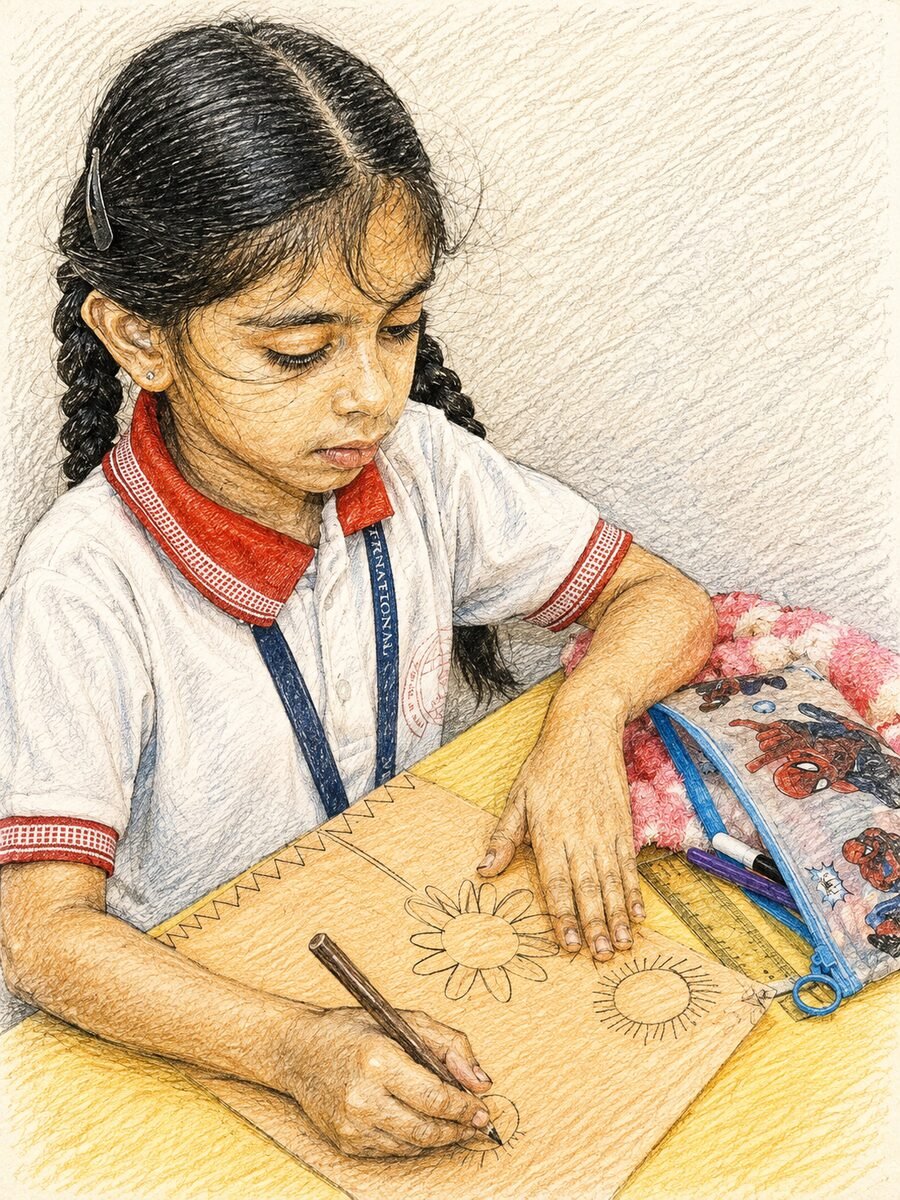
In Classes I and II, children are learning far more than letters and numbers. They are learning that school is a safe place, that questions are welcome, and that they are capable. Our Foundational Stage is designed around NEP 2020's 5+3+3+4 structure and NCF-FS 2022, with Foundational Literacy and Numeracy at its centre.
Class I children seated on the floor of the Foundational Lab, teacher kneeling alongside
Learn. Feel. Explore.
Express. Grow.
Our aim in these two years is to secure Foundational Literacy and Numeracy as envisioned in NEP 2020, while building moral values, Indian cultural rootedness and emotional intelligence. Learning is joyful and experiential — and it is deliberate.
- Foundational literacy and numeracy — competency-based lesson plans, with the goal of every child secure in FLN competencies by Grade 3.
- Values and cultural rootedness — ethics and courtesy practised daily, not taught as a subject.
- Emotional intelligence — developed across its five core components, with teachers who know each child.
Five domains of development · Panchakosha Vikas
Physical
Motor skills, coordination, health habits, active play.
Cognitive
Observation, reasoning, number sense, problem-solving.
Socio-emotional
Sharing, empathy, self-regulation, confidence.
Language & literacy
Listening, speaking, reading with understanding, writing.
Aesthetic & cultural
Art, music, movement, festivals, heritage.
What you would actually see in a Class I room
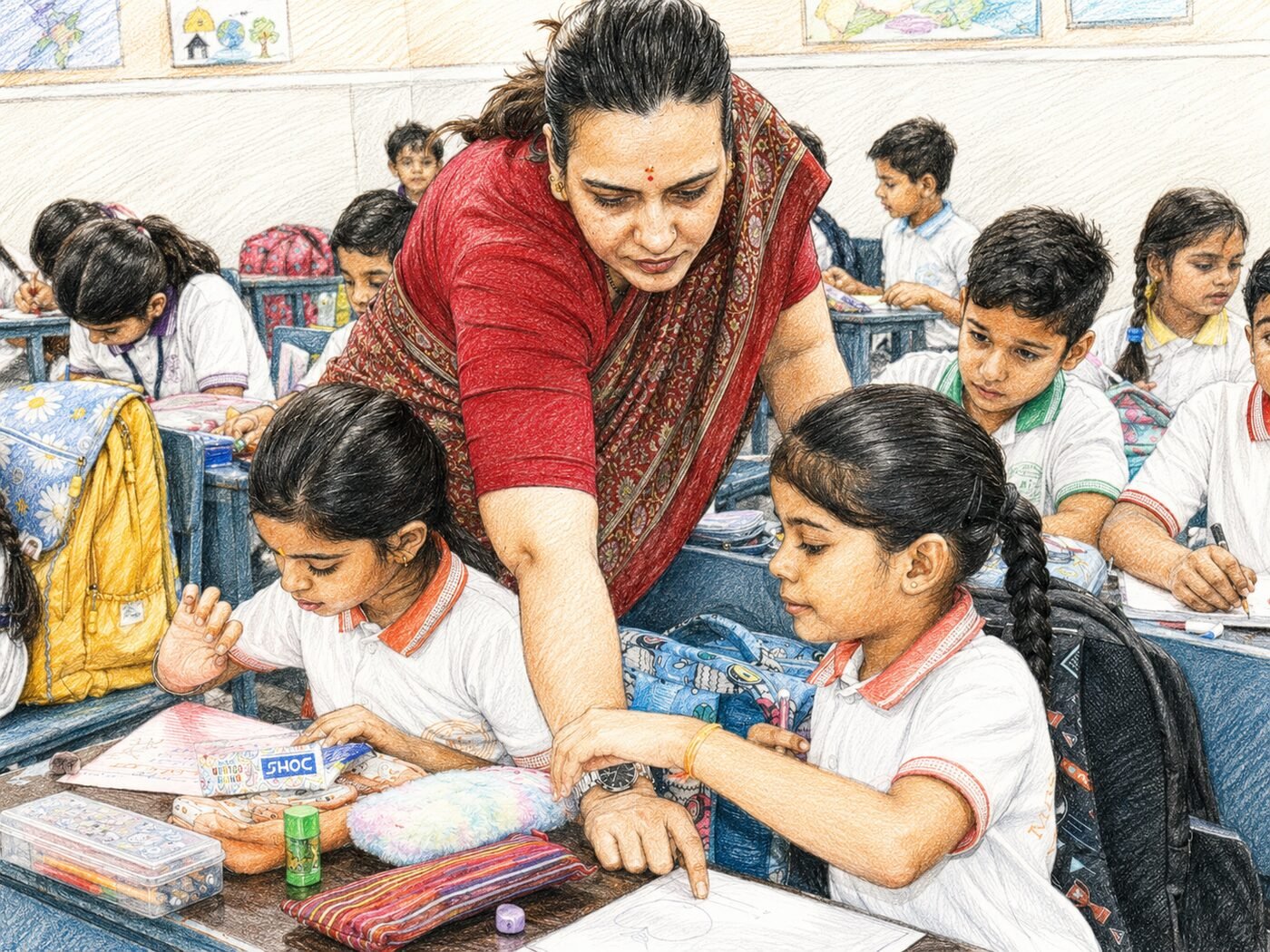
Not rows of silent children copying from a board. Our pedagogy is child-centric, play-based, activity-based and inquiry-driven — and it looks like it.
Play-way method
Number bonds built with counters and games. Phonics through rhyme, chant and movement. Children are on their feet as often as they are at a desk.
Learning by doing
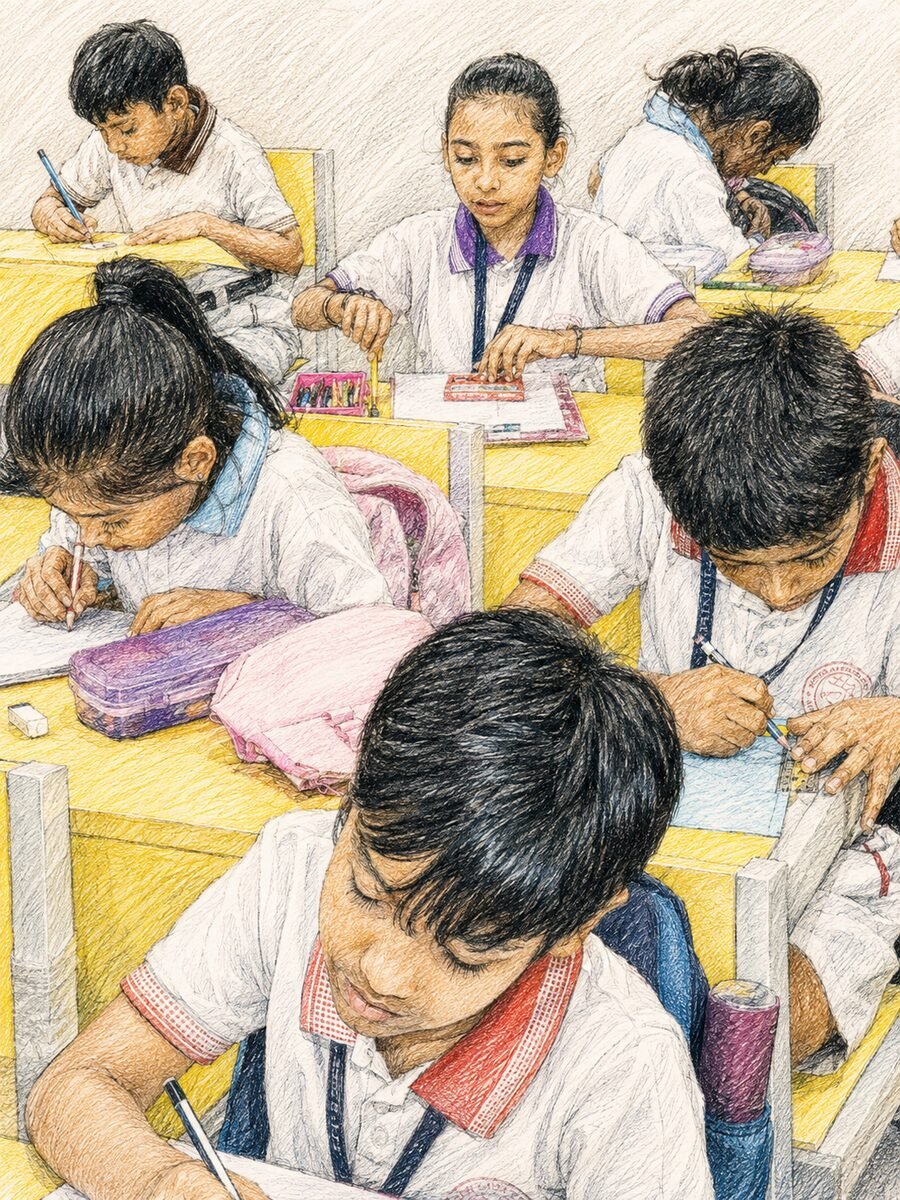
Activity-based lessons in the Foundational Lab and Play Zone: sorting, measuring, building, growing, observing — then talking about what happened.
Inquiry and exploration
Children's own questions drive part of the lesson. Teachers answer with another question as often as with a fact.
ICT-enabled lessons
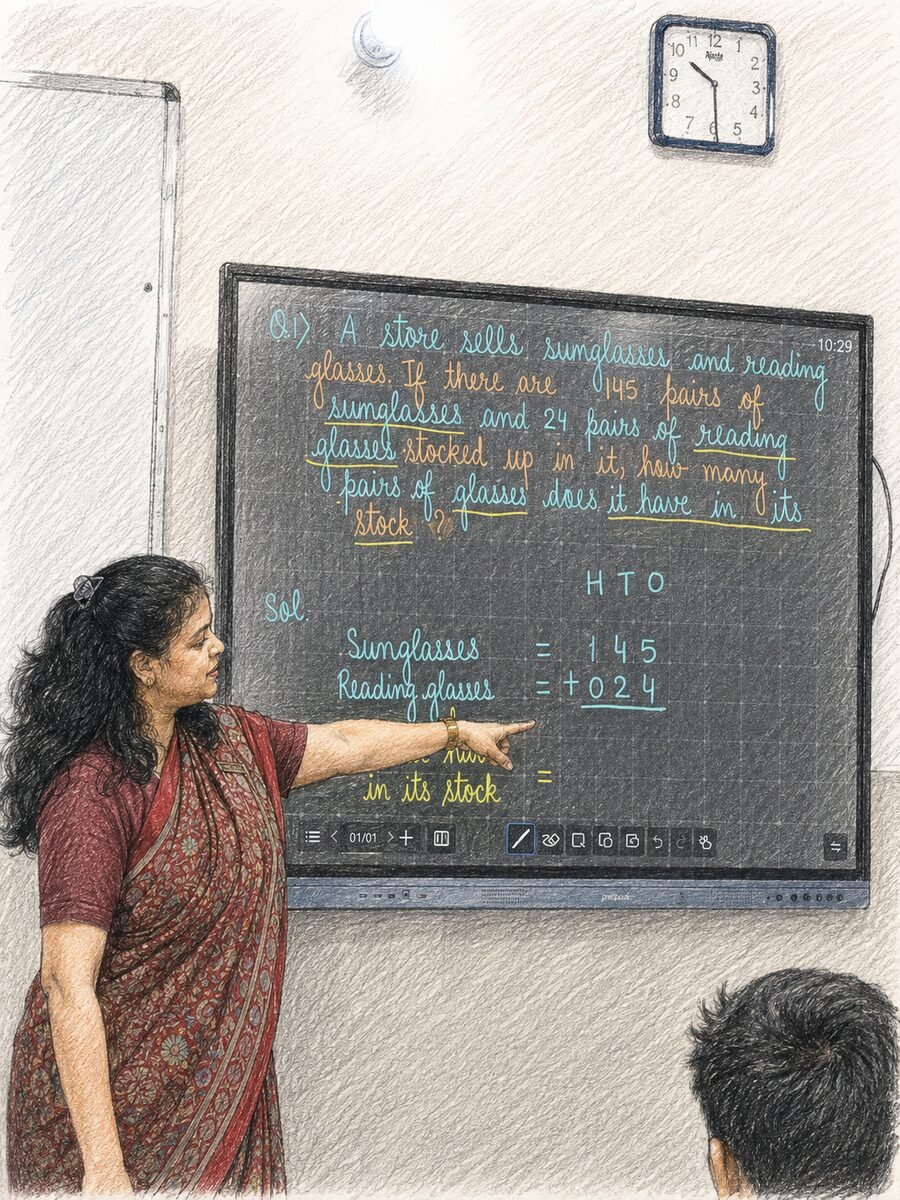
Interactive smart panels bring stories, sounds and visuals into the room — used in short, purposeful bursts, never as a substitute for the teacher.
Personalised attention
Class strength is held at 35–40, and every Grade 1 classroom has two trained teachers present at all times — so a child who needs help gets it in the moment.
Dedicated daily periods
Every subject has its own period each day, planned against clear competencies — so joyful learning is also structured learning.
What children learn — and how
Five scholastic areas, each planned around competencies rather than chapters. The left column is the subject; the right is what a child can actually do by the end of Class II.
English
Language & literacy
Listens with attention, speaks in full sentences, decodes and reads simple text with understanding, writes legibly and begins to write independently.
Hindi
Language & literacy
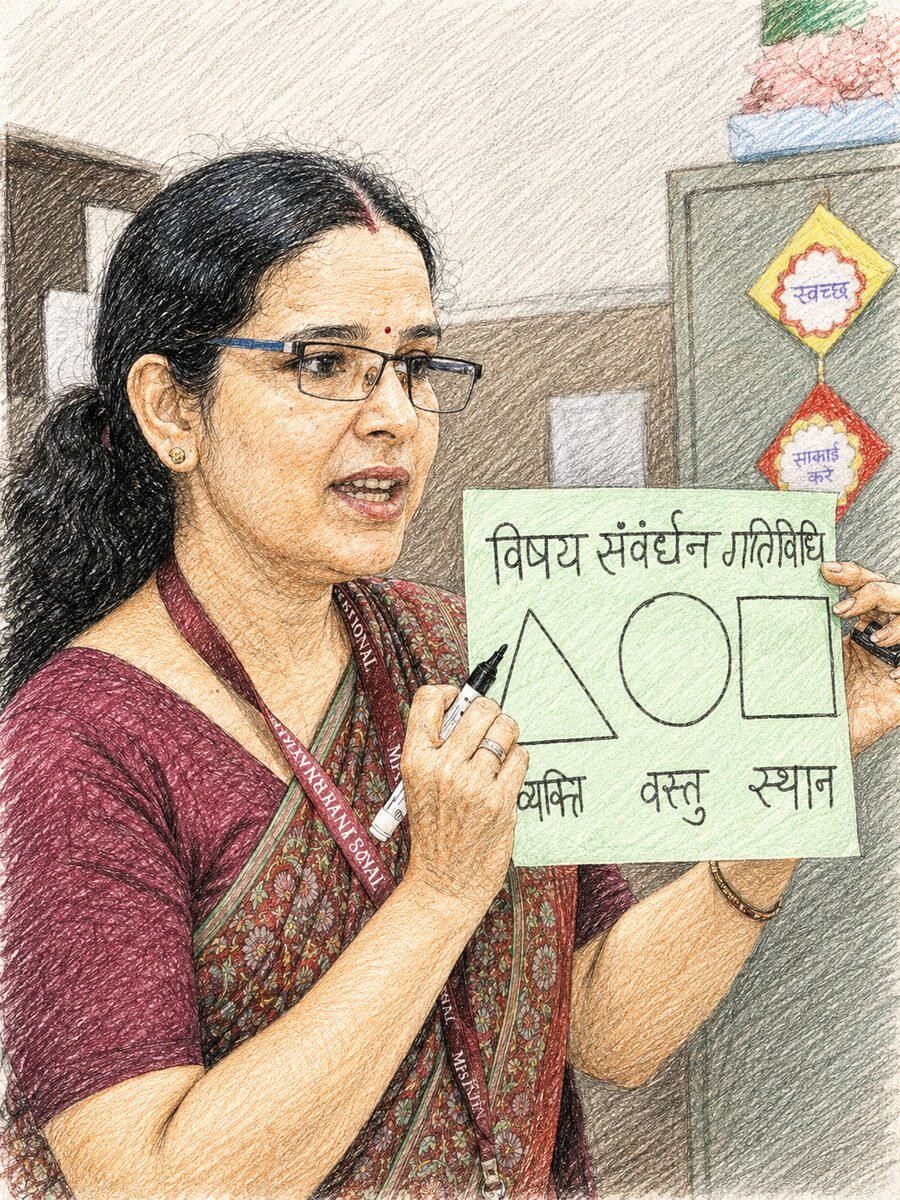
Reads and writes in Devanagari with confidence, recites and retells, and builds vocabulary rooted in the child's own world and culture.
Mathematics
Numeracy
Understands number, place value, addition and subtraction through concrete materials; recognises shapes, patterns and measurement in everyday situations.
Environmental Studies
The world around us
Observes, asks, sorts and describes — family, food, plants, animals, water, weather and neighbourhood — connecting classroom to home.
Computer Science
Early technology exposure
Age-appropriate, guided familiarity with digital tools, alongside habits of safe and sensible use.
Designed for young minds
Air-conditioned, well-ventilated classrooms with interactive smart panels, child-friendly furniture, and space to display what children make.
Smart panel lesson in progress
Smart classrooms
Interactive panels in every room, used in short purposeful bursts.
Foundational Lab, hands-on materials
Foundational Lab
A dedicated space for Classes I and II to learn by handling, making and testing.
Children at play in the Play Zone
Play Zone
Safe, vibrant and supervised — where a good deal of real learning happens.
Soft display board of children's work
Display boards
Soft boards in every room where children's work is shown, not stored.
Assessment that supports learning
“Assessment helps us understand how each child is growing — not simply what they can remember.”
There are no high-stakes examinations at this stage. In line with the applicable CBSE curriculum and assessment framework, we follow continuous and comprehensive evaluation and a Holistic Progress Card, rating progress across scholastic and co-scholastic domains.
Continuous observation
Multiple assessment strategies, subject enrichment activities, portfolio evidence and pen-and-paper tests where appropriate.
Competency-based worksheets
Regular practice and reinforcement, with additional support sheets for children who need them.
Anecdotal records
A systematic anecdotal register maintained by the class teacher, capturing behavioural and academic progress over the year.
360° holistic progress
Progress is reported across both scholastic and co-scholastic domains, so parents see the whole child.
Remedial teaching
Special remedial classes for learners who need reinforcement — arranged early, not at year end.
Safe, known and encouraged
For a six-year-old, feeling secure is the precondition for learning anything at all. These are the practices that make that real.
Emotional well-being
A dedicated Confession Room where a child can speak freely, and teachers who build genuine emotional connection with each student.
Recognition
Whiteboards outside each classroom name the week's Best Buddy, Best Orator, Most Disciplined and Class Topper — so effort of every kind is seen.
Values in practice
Children greet respectfully on entering the classroom. Courtesy is a daily habit rather than a lesson.
Safety and supervision
Grade 1 and 2 receive the highest priority: a support staff member stationed outside the classroom at all times, with continuous monitoring by security personnel.
Counselling
Periodic counselling sessions for students and parents, supporting emotional as well as academic well-being.
Academic support
Remedial classes and level-appropriate worksheets, so a child who is behind is helped rather than labelled.
Learning that doesn't stay at a desk
Co-scholastic programme
Every student gets an opportunity to participate in and lead the morning assembly, and children take part in inter-school competitions alongside our celebration of festivals and days of national and international importance.
School Parliament & 8 Houses
An active colour-coded house system that gives even our youngest children a first taste of responsibility, teamwork and democratic values.
MPS Darshan Channel
The school's own in-house news channel, building news reading, communication and early media literacy.
The SEWA initiative
A SEWA Almirah to which students and teachers contribute dry food for children in need — empathy learned by doing.
You will not be guessing how your child is doing
Around examination periods, we invite the parents of four to five students every day for a one-to-one discussion of their child's progress — so the conversation is unhurried and specific.
- 01Regular PTMs through the year.
- 02One-to-one progress discussions in the pre- and post-examination phases.
- 03Daily diary notes maintaining a reliable home–school connect.
- 04Structured parent feedback collected regularly and acted on.
- 05Counselling sessions for parents as well as students.
Questions parents ask us
Is there too much play and not enough academics?
Play is the method, not the alternative to academics. Every subject has a dedicated daily period and a competency-based lesson plan; children simply reach those competencies through activity, materials and talk rather than copying and repetition.
How will I know how my child is progressing?
Through the Holistic Progress Card, the class teacher's anecdotal record, regular PTMs, one-to-one discussions around examination periods, and daily diary notes.
What if my child needs extra help?
Remedial classes and additional level-appropriate worksheets are provided, and the two-teacher Grade 1 model means gaps are usually noticed within the lesson itself.
How safe is my child during the school day?
Grades 1 and 2 receive the highest priority: a support staff member is stationed outside the classroom at all times, with continuous monitoring and assistance from security personnel.
How much screen time is involved?
Interactive panels are used in short, purposeful segments to bring a story or concept alive. Technology supports the teacher here; it never replaces her.
We don't just teach.
We nurture.
Every child at MPS International should feel safe, valued, heard, supported — and inspired to learn. That is the work of Classes I and II.
Preparatory Stage · Classes III–V
From curiosity to understanding — exploring, practising and applying what they know.
Explore the Preparatory Stage ?